

Museums in Transition Meet the Digital Challenge
Do digital technologies merely dazzle museum visitors or also stimulate critical thinking?
In many public spaces, the use of technology often leads to individual isolation since, although sharing the same physical space, each person interacts only with their own screen or device. In the museum world, however, this trend does not always hold true.
More and more, museums worldwide are employing technological resources to encourage collective interaction and engage visitors with the cultural content they offer. They find validation to incorporate new technologies in research showing that interactive experiences increase knowledge retention and active participation among their visitors.
In this sense, audience studies conducted at institutions such as the Museum of Tomorrow (Rio de Janeiro) and the Victoria & Albert Museum (London) indicate greater emotional and cognitive involvement when visitors interact with digital resources, compared to static exhibitions, with strong potential to deepen their aesthetic and educational experience.
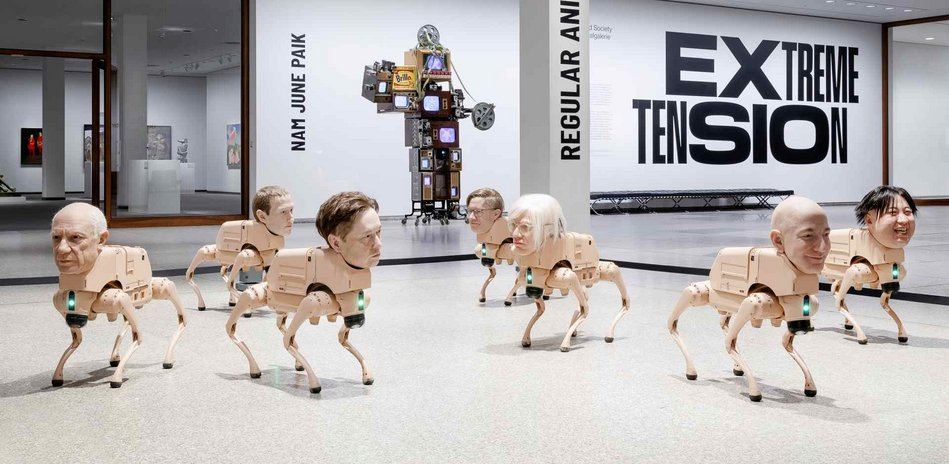
At the <i>Regular Animals</i> exhibition currently on display at Berlin’s Neue Nationalgalerie, for example, robot dogs with heads of well-known tech-world characters roam the exhibition space capturing images of the environment and reinterpreting them with AI. Occasionally, the robots eject versions of these images, which visitors may take home, proposing a critical reflection on the role of big tech and algorithms in shaping our worldview.
At the London Science Museum, visitors can simulate experiments and manipulate virtual models of physical and chemical phenomena, making complex concepts accessible and fun, especially for children.
Indeed, schools and universities bringing students to museums report that interactivity facilitates active learning, bridging science and art with everyday life, supported by surveys like those from the European Network of Science Centres and Museums.
Along the same lines, access for people with disabilities is expanded through, for example, smart audio guides, augmented reality for the blind, etc., reinforcing the argument for inclusion.
Critics, however, point out the risk of superficiality, emphasizing that an excess of overlapping sensory stimuli alongside contact with original artworks could reduce contemplation time, diverting focus to technological apparatus.
There are numerous and very diverse museums exploring the hybrid approach, and those that successfully integrate technology without replacing the physical collection tend to achieve better results. Digital resources, therefore, should be complementary, not the protagonist; their use must be conscious and balanced to avoid turning the visit into a mere technological spectacle. As Marcelo Mattos Araujo, director of a prominent cultural institution in São Paulo, states, “if [digital technologies] can help understand and visualize certain works, they cannot replace the original work, because it holds an aura, a value, an emotion that only these original objects possess.”
Cecilia Soares Esparta
Illustrative photo from the Beeple. Regular Animals exhibition at the Neue Nationalgalerie (Berlin), accessible at https://www.smb.museum/en/exhibitions/detail/beeple-regular-animals/